
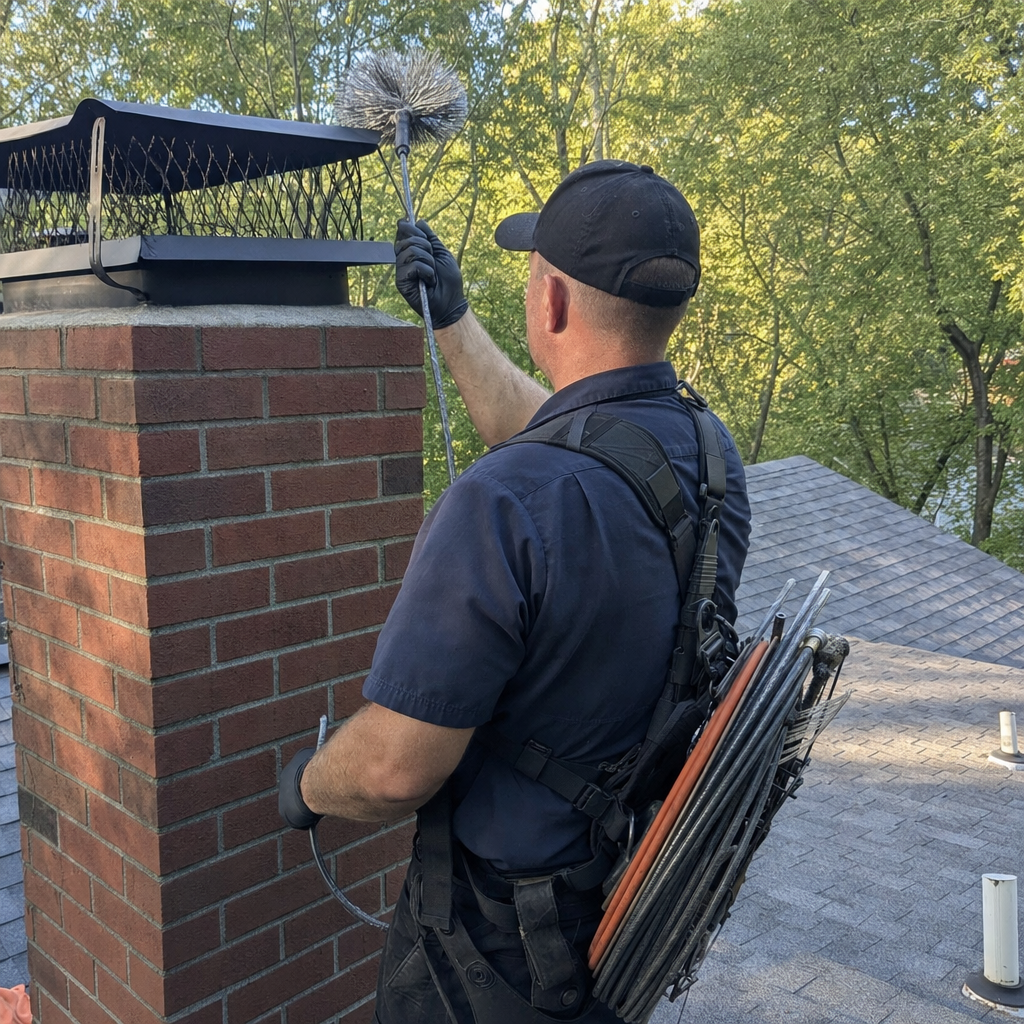
Chimney Flashing Repair in Nashville, TN: Why the Leak Usually Isn’t Just the Metal
Chimney flashing repair in Nashville typically costs $450–$1,200 depending on whether you’re resealing existing step flashing, replacing it entirely, or rebuilding the mortar joints the flashing anchors into. Most jobs we see in neighborhoods like East Nashville and Sylvan Park need the third option — not because roofers misdiagnose, but because they don’t open the masonry to see what’s underneath. If you’ve got water staining your ceiling near the chimney, call us at (855) 963-4743 and we’ll show you exactly where the water’s entering before you spend a dollar.

The Half-Right Diagnosis: When Roofers Stop at the Shingle Line
If a Nashville roofer told you the leak around your chimney is a flashing problem, they may be half right — on a 1940s brick chimney, the flashing usually fails because the mortar joints it’s anchored into have eroded, and no amount of fresh caulk fixes a crumbling mortar bed.
We’ve been up on enough roofs in Inglewood and 12 South to recognize the pattern. A homeowner calls a roofer for a leak. The roofer spots lifted step flashing, replaces or reseals it, and the leak stops — for six months, maybe a year. Then it comes back worse, because the real problem was the soft lime mortar behind the flashing that Nashville’s freeze-thaw cycles had turned to sand. The new caulk or metal was sitting on a foundation that couldn’t hold it.
Here’s what’s actually happening on these older masonry chimneys:
- Step flashing is L-shaped metal pieces woven into each course of shingles and bent up against the chimney brick, with the vertical leg tucked into a mortar joint and sealed
- Counter flashing is the cap piece cut into the mortar joints above, overlapping the step flashing like a roof overhang
- On pre-1950s Nashville chimneys, that mortar joint is soft lime-based mix — breathable and flexible in its day, but prone to erosion once moisture gets in
- Once the joint degrades, the flashing loses its anchor point; wind lift, thermal expansion, and ice formation do the rest
Nashville sits in a freeze-thaw transition zone that subjects brick and mortar to repeated expansion-contraction cycles each winter — more damaging to the soft lime mortar common in pre-1950s chimneys than the consistently colder winters of Knoxville or the consistently milder winters of Memphis. Water gets under the metal, freezes, expands, and progressively separates the flashing from the masonry. From the roof, you’ll see lifted edges, corrugated or wavy metal, or gaps where the counter flashing no longer seats flush. From inside, you see the stain on your ceiling that grows every spring thaw.
This is why we approach chimney flashing repair as a masonry diagnosis first, metal repair second. Michael Brown, our Owner and Lead Technician, carries a chimney camera specifically to trace water paths — we’ll show you the joint erosion or crown crack that’s driving the leak before we quote any work. That’s not something a roofing crew typically has in their truck.
Three Repair Scenarios: What You Actually Get for Your Money
Not every chimney flashing repair in Nashville is a full rebuild. The key is matching the repair to the actual failure mode — which means knowing what to look for before the estimate. Here’s how we break it down after inspection:
| Repair Type | What’s Included | Typical Nashville Cost Range | When It’s the Right Call |
|---|---|---|---|
| Flashing Reseal (Caulk/Repoint Bed) | Remove old sealant, apply new polyurethane or silicone sealant at counter flashing base, minor mortar bed touch-up | $450–$650 | Metal is sound, mortar joints are intact, leak is minor and recent — typically under 2 years old |
| Step & Counter Flashing Replacement | Remove existing metal, install new copper or galvanized step flashing, new counter flashing cut into mortar joints, seal | $800–$1,100 | Metal is corroded, bent, or improperly installed; mortar joints still structurally sound |
| Full Flashing + Mortar Joint Repointing | Grind out deteriorated mortar to proper depth, repoint with matching mortar mix, install new step and counter flashing, crown seal if needed | $950–$1,500+ | Mortar joints are eroded or “sugaring” — the root cause on most pre-1950s Nashville chimneys we see |
The gap between option two and option three is where homeowners get caught. A roofer quotes option two because the metal is visibly failed. Sixteen months later, the new flashing lifts because the joint it was cut into has continued to degrade. We’ve done follow-up repairs in Germantown and East Nashville where the homeowner paid for flashing replacement twice — once from a roofer, once from us to do it right.
Our full-system capability means flashing repair doesn’t require a second contractor. Michael handles the masonry component and coordinates the metal work, which matters for accountability when two trades share one problem. We use Chimney Repair protocols that include mortar analysis — we’ll match the new mortar’s compressive strength and permeability to the original lime mix, not slap on hard Portland cement that traps moisture and accelerates the next round of spalling.
Why Nashville’s Housing Stock Makes This a Specialist Job
Nashville’s established inner neighborhoods — East Nashville, Inglewood, Sylvan Park, 12 South, and Germantown — are dense with 1910s–1950s craftsman bungalows and brick foursquares that retain original clay-tile-lined masonry chimneys, many of which have never been relined and show significant cracking from decades of thermal cycling and settling. These chimneys weren’t built with modern flashing details. The original step flashing was often galvanized steel, sometimes copper, embedded in mortar that was never meant to last 80 years.
The city’s intense renovation-flip market has compounded the problem. Cosmetic fireplace updates — new tile surrounds, gas log inserts — are routinely installed without any liner inspection, leaving new owners with a code and safety gap they typically don’t know exists. We’ve found gas log inserts dropped into original clay tile flues during quick flips, without resizing or relining for the new appliance. That’s a direct NFPA 211 violation, and it’s the out-of-state investor who lists the property on Airbnb who usually doesn’t know — but it’s the guest who gets the carbon monoxide risk.
That short-term rental angle matters for flashing too. Those properties see higher turnover, less consistent maintenance, and more “ambiance” fires burned at low temperatures that produce creosote faster than normal residential use. A clean chimney isn’t a luxury — it’s just maintenance you can see the point of when something goes wrong. The same goes for flashing: by the time you see the ceiling stain, water has been working on that mortar joint for multiple seasons.
We use professional-grade materials suited to this repair scope — HeatShield for crown resurfacing when the crown has contributed to the leak path, Gelco and Olympia Chimney components for cap and termination work that integrates with the flashing system, and Famco hardware where custom fabrication is needed. These are the same material lines specified by certified chimney specialists nationwide, not generic big-box alternatives.
Our Inspection Process: Finding the Real Entry Point
When you call (855) 963-4743 for a flashing-related leak, here’s what actually happens:
- Interior assessment — we trace the stain pattern, check for active moisture, and rule out non-chimney sources (condensation, plumbing, roof valleys)
- Roof-level examination — we photograph the step flashing, counter flashing, crown, and visible mortar condition
- Chimney camera scan — we run a visual inspection of the flue and smoke chamber to identify any secondary water damage or liner compromise
- Mortar joint probe — we test joint depth and integrity with a specialized tool; “sugaring” or powdering mortar indicates the joint is failed behind the surface
- Written report with images — you see what we see, with a single recommendation that addresses root cause, not symptom
This is where eight years of Nashville-specific work shows. We’ve seen how water behaves on a 12-pitch Craftsman roof in Sylvan Park versus a shallow-slope foursquare in Inglewood. We know which block faces catch the prevailing wind-driven rain, and which chimney orientations trap ice at the uphill side. That local pattern recognition means fewer misdiagnoses and fewer callbacks.
Our 775 verified reviews averaging 4.9 stars reflect this — nearly 800 homeowners have trusted us with their chimney systems, and the consistency of that feedback comes from Michael leading every job, not delegating to a rotating crew. When the person diagnosing your flashing is the same person grinding out the mortar joint, there’s no information lost between inspection and repair.
FAQs
Most chimney flashing repair in Nashville costs between $450 and $1,200, with simple reseals at the low end and full step flashing replacement with mortar repointing at the high end. The exact price depends on whether the leak is just failed sealant, corroded metal, or degraded mortar joints behind the flashing — which is why we inspect before quoting. Call (855) 963-4743 for a free estimate with no obligation.
We can complete simple reseals and minor touch-ups same-day if the weather permits and materials are in stock, but most proper flashing repairs require scheduling a return visit with the correct mortar mix and metal fabricated to your chimney’s dimensions. We’d rather do it once than rush a repair that fails next spring. Call (855) 963-4743 and we’ll give you a realistic timeline based on what we find.
Repairing with caulk is cheaper upfront — typically $450–$650 — but it’s only the right choice if the mortar joints and metal are fundamentally sound. Replacing failed flashing with new metal and properly repointing the anchor joints costs more initially but eliminates the repeat-leak cycle that costs far more in ceiling repair, mold remediation, and frustration. We show you which category you’re in before you decide. Call (855) 963-4743 for an inspection that answers this for your specific chimney.
Call a chimney specialist if your home has a masonry chimney, especially one built before 1950 — the leak is probably originating in mortar joint failure that a roofer won’t diagnose because it requires opening the masonry, not just replacing shingles and metal. Call a roofer if the chimney is factory-built metal or if the leak appears to be from damaged roofing material away from the chimney itself. When in doubt, we inspect at no charge and will tell you honestly if you need a roofer instead. Call (855) 963-4743.
Ready to Stop the Leak for Good?
Chimney flashing repair done right means fixing the masonry that holds the metal, not just the metal itself. If you’re seeing ceiling stains, hearing drips during Nashville’s spring rains, or you’ve already had one “repair” that didn’t last, call (855) 963-4743 for a free inspection. Michael Brown will show you exactly where your water’s coming from, explain what it actually takes to stop it, and give you an upfront price before any work begins. Eight years, one standard — from sweep to rebuild, we handle the whole system.
Written by Michael Brown, Owner & Lead Technician at Apex Chimney Cleaning Service Nashville, serving Nashville, TN.