
How Often Should You Clean Your Chimney in Nashville? For Most Homes, Once a Year — But Nashville’s Short-Term Rental Market Changes Everything
For a typical Nashville homeowner burning seasoned hardwood in a well-maintained fireplace, the NFPA guideline of one professional chimney cleaning per year holds up fine. If you’re operating a short-term rental in East Nashville, Germantown, or Sylvan Park with guests lighting ambiance fires every weekend from October through March, you’re looking at a compressed creosote cycle that demands cleaning every six months — sometimes more. Call (855) 963-4743 and we’ll tell you exactly where your property falls after a camera inspection.

Why the “Once a Year” Rule Falls Short for Nashville’s Rental Market
Nashville’s become one of the densest short-term rental markets in the country, and that’s not just a zoning conversation — it’s a chimney maintenance problem most property owners don’t know they have.
Here’s what we’ve learned from eight years on Nashville roofs: guests don’t build fires the way residents do. A homeowner in Inglewood burning four cords of oak through January loads the firebox hot and full, hitting temperatures that burn relatively clean. A bachelorette party in a Sylvan Park Airbnb lights a small decorative fire at 6 PM, throws on a couple of half-damp logs from the convenience store, and lets it smolder for atmosphere. That low-temperature, oxygen-starved burn produces exponentially more creosote than a proper hot fire.
We’ve pulled flues in Germantown rentals that were glazed solid after a single season of guest use. The NFPA 211 standard wasn’t written for that burning pattern. It assumes knowledgeable occupants, seasoned fuel, and fires built for heat. None of those three things reliably exist in a Nashville Airbnb.
The practical framework we use after inspecting a chimney:
- Owner-occupied, moderate use (1–2 fires weekly): Annual cleaning, typically in early fall before the first Nashville cold snap
- Active short-term rental with wood-burning fireplace: Every 6 months, with a camera inspection to track creosote buildup rate
- High-volume residential (3+ cords per season): After every cording season, or mid-season if you notice drafting issues or smoke spillage
- Gas log insert in original clay flue: Annual inspection minimum — and frankly, many of these installations in Nashville’s flipped bungalows need immediate liner evaluation before any use
Michael Brown, our Owner and Lead Technician, grew up in East Nashville back when the neighborhood was more hardware stores than coffee shops. He learned venting systems through Nashville State Community College’s building trades program, then spent years alongside older tradesmen who drilled into him that a clean flue is the difference between a cozy winter and a house fire. What stuck with him most was his own father’s Donelson fireplace getting condemned by a home inspector when Michael was nineteen — preventable, unexpected, expensive. That’s why we don’t quote blanket schedules without seeing the flue first.
Nashville’s Older Housing Stock: Why Clay Tile Changes Your Cleaning Interval
Nashville’s inner neighborhoods — East Nashville, Inglewood, Sylvan Park, 12 South, Germantown — are packed with 1910s to 1950s craftsman bungalows and brick foursquares. Most retain original clay-tile-lined masonry chimneys that have never been relined. Those clay tiles crack. It’s not a question of if; it’s a question of how badly and how that affects what sticks to them.
A smooth stainless steel liner — we install DuraFlex and Olympia Chimney systems when relining is warranted — sheds creosote more predictably. A cracked clay tile flue traps combustion byproducts in irregular surfaces and mortar joints. You can clean it spotlessly today and have significant buildup in the same spots six months later because the surface itself is compromised.
Nashville sits in a brutal freeze-thaw transition zone. Our winters swing from 15°F to 55°F and back again, repeatedly expanding and contracting brick and mortar. The soft lime mortar in pre-1950s chimneys takes that worse than harder Portland cement mixes would. Add nearly 47 inches of annual rainfall and the humidity that comes with it, and you’ve got moisture intrusion accelerating spalling, joint failure, and crown cracking — all of which create more surface irregularity for creosote to grab onto.
What this means practically: if you own one of these older Nashville homes and you’re still running original clay tile, your “annual” cleaning might need to happen every eight to ten months based on use. We’ve had East Nashville clients where we recommended moving to a spring-and-fall cycle after the camera showed thermal cracking concentrated in the smoke chamber. We don’t upsell relines — we show the footage, explain the buildup pattern, and let the homeowner decide.
The Renovation-Flip Problem Hiding in Nashville’s Rental Properties
Here’s a scenario we encounter constantly in Nashville’s renovation-hot neighborhoods: a flipper buys a 1925 foursquare in Sylvan Park, installs a gas log insert and new tile surround, lists it on Airbnb, and never checks whether the flue was resized or relined for the new appliance. The out-of-state investor owner has no idea this is an NFPA 211 violation. The guests have no idea the fireplace they’re Instagramming might be venting into a cracked clay flue never intended for gas appliance temperatures and condensation patterns.
We find these during routine inspections — gas logs running in original clay flues with no liner, no proper sizing, sometimes no cap keeping rain out of the system. The guest-use factor compounds it: intermittent, low-temperature operation produces acidic condensation that degrades mortar faster than continuous residential use would.
If you’re a Nashville property owner and you didn’t personally verify liner condition before purchase, assume it needs inspection. We’ve seen too many owners learn this the hard way through water damage, failed home inspections at resale, or worse.
What Actually Happens During a Cleaning — And What the Camera Reveals
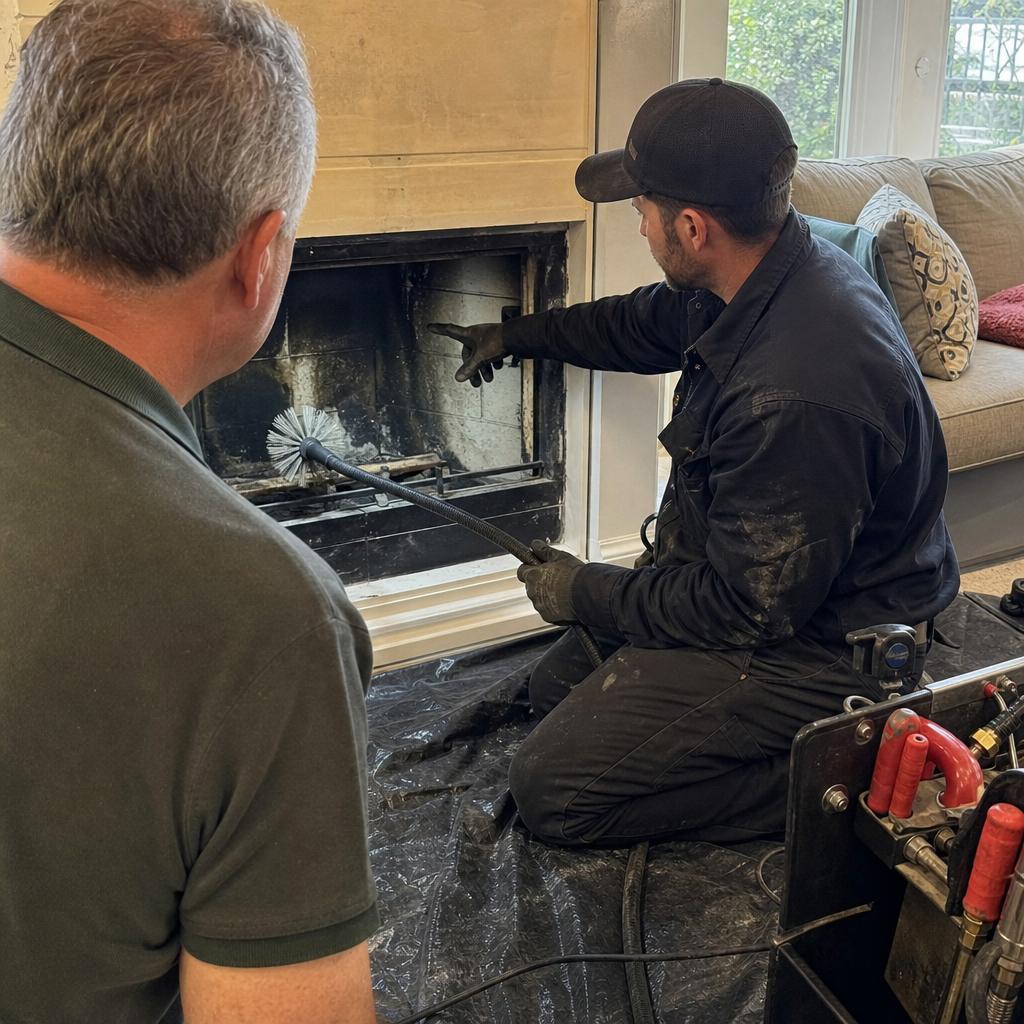
Our Chimney Cleaning & Sweep in Nashville follows a sequence we’ve refined over eight years and 775 verified reviews. Michael leads every job personally — no rotating subcontractors, no technician you can’t name later if something needs follow-up.
The sweep itself uses professional-grade rotary brushes and HEPA-contained vacuums. But the critical piece for determining your actual cleaning frequency is the camera inspection: we run a high-resolution chimney camera from firebox to cap, documenting flue condition, creosote type and thickness, liner integrity, and any obstruction or damage.
There are three stages of creosote, and they dictate both cleaning method and how fast they’ll return:
- Stage 1 (sooty, brushable): Normal accumulation, standard rotary cleaning removes it completely
- Stage 2 (granular, harder): Indicates cooler fires or poor draft — needs more aggressive mechanical cleaning and often signals you should burn hotter or inspect the chimney cap and flue sizing
- Stage 3 (glazed, tar-like): Requires chemical treatment or mechanical removal with specialized chains; indicates serious combustion problems and often means your cleaning interval was too long
We use HeatShield for smoke chamber parging and crown repair when we find deterioration, and Gelco caps for replacement installations — the same materials specified by certified chimney specialists nationwide. After the inspection, we tell you honestly whether you’re on an annual cycle, need to tighten to six months, or can stretch longer based on what we found. Our 4.9-star reputation across nearly 800 Nashville homeowners exists because we don’t pad bills with unnecessary work.
Signs You’re Due — Regardless of the Calendar
Even with a scheduled cleaning plan, certain symptoms mean call sooner:
- Smoke spilling into the room on startup, especially in Nashville’s older homes with already-marginal draft
- Strong, acrid odor from the fireplace in humid weather — creosote absorbs moisture and off-gases
- Visible black buildup on damper or firebox walls beyond normal soot
- Reduced draft performance, or the fire seems to “struggle” compared to previous seasons
- Any water staining on interior chimney walls — Nashville’s rainfall volume makes this a common early warning
- Debris or animal nesting material in the firebox — we’ve pulled everything from squirrel caches to chimney swift nests
A clean chimney isn’t a luxury — it’s just maintenance you can see the point of when something goes wrong.
Key Takeaways: Your Nashville Chimney Cleaning Schedule
- Standard residential use: Annual professional cleaning and inspection, ideally before first use each fall
- Short-term rental properties (Airbnb/VRBO) in Nashville: Every 6 months due to guest fire-building patterns that accelerate creosote
- High-volume wood burners: After each cording season, with mid-season inspection if you burn more than 3 cords
- Original clay tile flues in pre-1950s Nashville homes: May need tighter intervals due to cracked surfaces trapping more buildup
- Gas log inserts in original flues: Annual inspection minimum, with liner evaluation strongly recommended
FAQs
A standard chimney sweep and inspection for a Nashville residential fireplace typically runs $175–$275, with multi-flue properties, severe creosote buildup, or camera inspection of inaccessible flues adding to that base. Short-term rental properties needing more frequent service can sometimes arrange reduced-rate recurring schedules. Call (855) 963-4743 for an exact quote — estimates are free, and we’ll tell you honestly whether you need standard service or something more involved.
DIY chimney cleaning kits cost $50–$100 but leave you blind to what actually matters: flue liner condition, crown integrity, and creosote stage assessment that requires a camera. In Nashville’s older housing stock with original clay tile and frequent moisture intrusion, the hidden damage is what burns houses down — not the soot you can reach with a brush. We don’t recommend DIY for anything beyond very basic, accessible firebox cleaning, and never for properties you rent to guests where liability exposure is significant. Call (855) 963-4743 if you want to know what you’re actually dealing with up there.
During peak season (October through January), we typically book 3–5 days out, though we maintain emergency slots for drafting failures, suspected blockages, or pre-sale inspection deadlines. Off-season scheduling is usually more flexible, and we actively encourage Nashville short-term rental owners to book spring cleanings when availability is better and pricing may be more favorable. Call (855) 963-4743 — we’ll get you the first available slot that works.
If guests operate your wood-burning fireplace, you almost certainly do. The combination of small ambiance fires, unfamiliarity with damper operation, and inconsistent fuel quality in rental settings produces Stage 2 or 3 creosote faster than residential use. After our initial camera inspection, we’ll classify your property’s buildup rate and recommend either standard annual, accelerated 6-month, or custom intervals based on actual use patterns and flue condition. Call (855) 963-4743 to schedule that baseline inspection — it’s the only way to set an honest schedule.
If you’d rather have it looked at, Apex Chimney Cleaning Service Nashville offers a no-pressure assessment in Nashville — call (855) 963-4743.
Written by Michael Brown, Owner & Lead Technician at Apex Chimney Cleaning Service Nashville, serving Nashville, TN.