
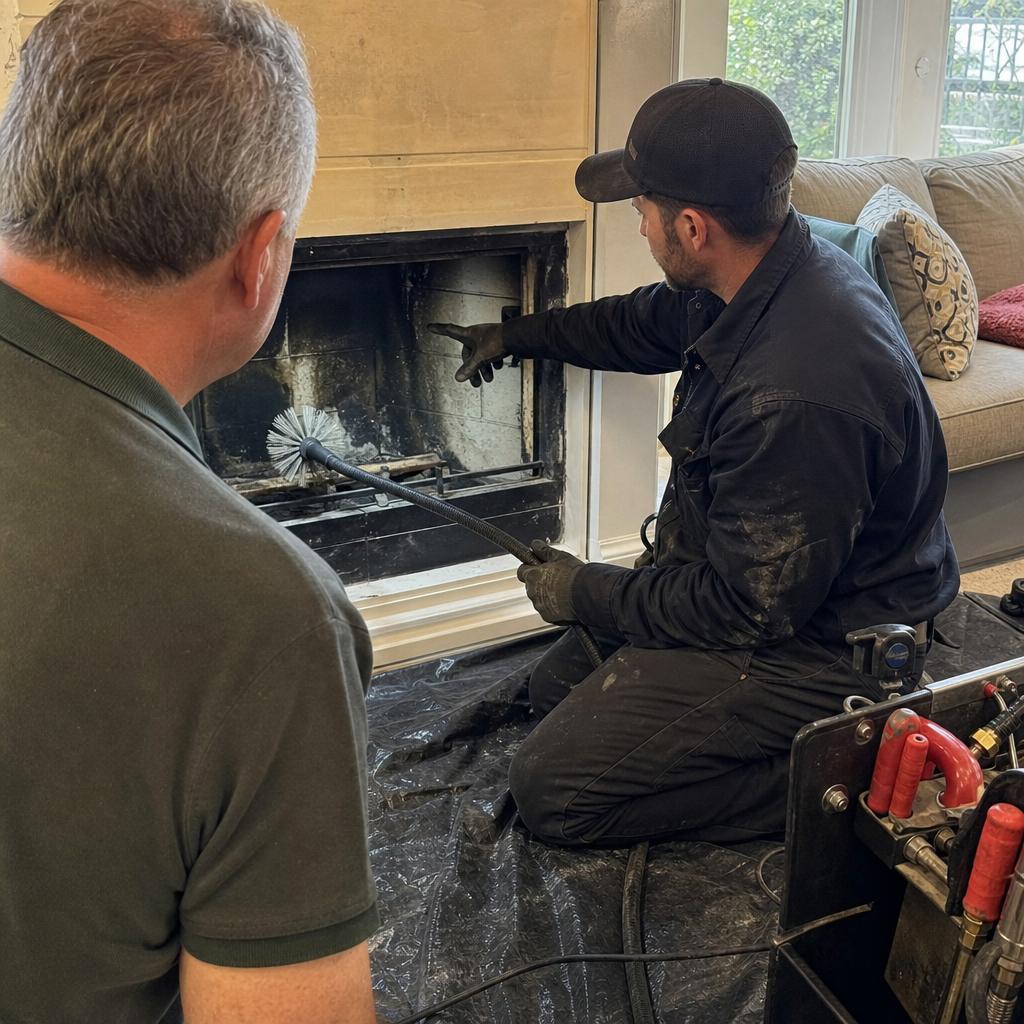
Signs Your Chimney Needs Cleaning in Nashville: The Early Warnings Most Homeowners Miss
If you’re noticing unusual odors, slow-burning fires, or visible debris in your firebox, your chimney likely needs cleaning. In Nashville’s humid climate with its high concentration of older clay-tile-lined chimneys, these signs often appear earlier and progress faster than in drier regions — and the subtle indicators are easy to mistake for HVAC or weather issues. Call (855) 963-4743 if you want a technician to confirm what you’re seeing.

Last July, we got a call from a homeowner in Sylvan Park who swore her attic had a mold problem. The smell hit you walking through the front door — musty, sharp, almost chemical. She’d had the HVAC ducts cleaned, the attic inspected, even replaced a section of bathroom exhaust vent. The real source was her chimney: a clay tile flue packed with stage-2 creosote that had spent the summer absorbing Nashville’s humidity and off-gassing into her living room every time the central air created negative pressure. That’s the thing about chimneys in this city. The obvious signs — visible soot, smoke backing up into the room, a roaring chimney fire — those are late-stage. The earlier signals are quieter, and most of them aren’t in the firebox where you’d think to look.
Why Nashville’s Humidity Changes What “Dirty” Looks Like
Nashville averages nearly 47 inches of rainfall annually with humidity that hangs heavy from May through October. That moisture doesn’t stay outside. It works its way into chimney systems through cracked crowns, deteriorated mortar joints, and the porous surface of clay tile flues themselves.
Here’s what happens inside a typical East Nashville or Germantown chimney: creosote deposits and organic debris — bird nests, leaf litter, the occasional squirrel’s winter cache — absorb that atmospheric moisture during the off-season. The resulting microbial activity produces a musty, acrid odor that homeowners routinely misattribute to their air handler, attic insulation, or “just old house smell.” By the time the odor is strong enough to prompt a service call, the flue condition has often progressed well beyond a routine sweep.
We’ve found the same pattern across Inglewood and 12 South — neighborhoods dense with 1920s brick foursquares and craftsman bungalows whose original clay liners have never been relined. The humidity amplifies what would be a minor maintenance issue in a drier climate into a noticeable air quality problem. If you’re catching a whiff of something sour when you walk past the fireplace in July, that’s not your imagination, and it’s probably not your attic.
Firebox Clues Specific to Clay Tile Flues
Nashville’s older housing stock carries a distinctive warning system that metal or cast-in-place liners don’t replicate. When we inspect fireboxes in original clay-tile-lined chimneys — still the majority in pre-1950s construction — we look for material that doesn’t belong there.
Small tile fragments or rust-colored granules collecting on the smoke shelf or firebox floor indicate spalling: the clay liner surface is fracturing from repeated thermal stress. Each heating cycle expands the tile; each cooldown contracts it. After eighty or ninety years of this, the glaze layer fails and the body of the tile begins to shed. Those granules are your liner telling you it’s deteriorating faster than an exterior inspection would suggest.
This matters because spalling clay tile creates two parallel problems:
- The rough, fractured surface traps creosote more aggressively than smooth tile, accelerating buildup
- The thinning tile wall loses insulating capacity, increasing the risk of heat transfer to surrounding combustibles
We’ve pulled handfuls of these granules from chimneys that “worked fine last year” — the homeowner’s exact words, nearly every time. Michael Brown, our Owner and Lead Technician, has heard that phrase so often he can practically time his response to it. Then the camera goes up, and the footage shows stage-2 glazed creosote coating a liner that’s shedding material into the flue. The early signs were there. They just didn’t look like chimney signs.
For properties where the liner has advanced deterioration, we specify HeatShield resurfacing systems or Olympia Chimney stainless steel relining products — the same materials certified chimney specialists use nationwide. The choice depends on what the camera inspection reveals about the extent of tile loss and flue geometry.
The Short-Term Rental Factor: Compressed Cleaning Cycles
Nashville’s status as a top national destination for bachelorette parties and tourism has produced one of the highest short-term rental densities in the country. Many of those Airbnb and VRBO properties in East Nashville, Sylvan Park, and Germantown feature working wood-burning fireplaces that guests treat as ambiance features rather than heating appliances.
The result is a cleaning cycle compression that doesn’t exist at this scale in comparable mid-South cities. Guests build small, low-temperature fires — the exact conditions that produce the most creosote. They use wax fire starters, colored fire glass, and occasionally accelerants that leave residue incompatible with normal combustion. We’ve found chimneys in rental properties that needed cleaning after a single heavy rental season, not the standard annual interval.
For rental owners, these are the post-guest indicators that should trigger an immediate cleaning check regardless of calendar date:
- Fire glass or decorative stones left in the firebox that weren’t there before — evidence of improper fire-building
- Waxy residue or synthetic odor in the firebox after guest departure
- Guest complaints about “smoky smell” or difficulty getting the fire started
- Excessive ash volume relative to the wood supply — a sign of incomplete combustion from low-temperature burning
We’ve also encountered the renovation-flip complication repeatedly: a gas log insert dropped into an original clay tile flue during a quick cosmetic update, without resizing or relining for the new appliance. That’s a direct NFPA 211 violation that leaves the property owner — often an out-of-state investor completely unaware — with a code and safety gap. We document these with camera footage and provide the technical specification for corrective work, whether that’s a Gelco liner system or full rebuild.
Draft Anomalies: When “Cold Flue” Is the Wrong Diagnosis
Homeowners in Nashville call us every October with the same complaint: the first fire of the season smokes into the room for the first few minutes, then “settles in.” The conventional wisdom says cold air in the flue is blocking the initial draft. Sometimes that’s true. Often, it’s not.
A fire that burns unusually slow — flames that lap rather than dance, wood that chars without fully combusting — can indicate partial flue restriction from creosote buildup or debris obstruction. The flue isn’t cold; it’s choked. The distinction matters because lighting a newspaper roll to “warm the flue” won’t solve a physical blockage, and repeated attempts can overheat restricted areas.
Similarly, a smoke smell that persists during the first ten to fifteen minutes of a fire, not just the first two, suggests the flue isn’t clearing properly. In Nashville’s older chimneys, we’ve traced this to:
- Creosote buildup narrowing the flue cross-section by 25% or more
- Bird nests or squirrel debris partially obstructing the flue — especially common in capless chimneys
- Structural liner damage creating turbulence that prevents clean exhaust flow
The freeze-thaw cycling that Nashville’s chimneys endure each winter — more damaging to the soft lime mortar of pre-1950s construction than the consistently cold winters of Knoxville or the milder winters of Memphis — compounds these issues by accelerating mortar joint deterioration and crown cracking. Moisture intrusion follows, and moisture plus creosote equals accelerated degradation.
What a Professional Chimney Inspection Actually Reveals
We’ve built our Chimney Cleaning & Sweep process around eliminating the guesswork. Michael leads every job personally, and the inspection protocol reflects what eight years of Nashville-specific chimney work has taught us.
The exterior visual checks for crown condition, cap integrity, and mortar joint deterioration. The interior camera inspection — non-negotiable in our process — reveals what no flashlight-and-mirror method can: the actual surface condition of the flue liner, the degree and type of creosote deposition, and any obstruction or structural anomaly.
We classify creosote by stage, not just volume:
| Creosote Stage | Appearance | Removal Method | Typical Nashville Context |
|---|---|---|---|
| Stage 1 | Sooty, flaky, easily brushed | Standard rotary sweep | Annual maintenance fires, proper burning |
| Stage 2 | Crunchy, honeycomb texture | Mechanical removal with chains or whips | Most common finding in “works fine” chimneys |
| Stage 3 | Glazed, tar-like, hardened | Chemical treatment plus mechanical removal | Restricted air supply, unseasoned wood, rental properties |
Stage 2 is where most Nashville homeowners live — unaware. It doesn’t produce dramatic symptoms. The fire still draws. The room doesn’t fill with smoke. But the creosote is accumulating, hardening, and reducing the safety margin with every burn. Our 775 verified reviews averaging 4.9 stars include hundreds from homeowners who scheduled a routine sweep and discovered they were closer to a problem than they knew.
Key Takeaways: When to Schedule Cleaning Sooner Than Annual
- Humidity-amplified odors in summer months — musty, acrid smells near the fireplace that worsen with air conditioning operation
- Clay tile debris in the firebox — small fragments or rust-colored granules indicating liner spalling
- Draft anomalies — slow-burning fires, persistent smoke smell beyond the first minutes, or flames that lack normal vigor
- Short-term rental turnover — guest use of improper fire-starting materials or complaints about smoke or odor
- Post-renovation occupancy — any gas insert or cosmetic fireplace update performed without documented liner inspection
A clean chimney isn’t a luxury — it’s just maintenance you can see the point of when something goes wrong. We’ve seen the wrong, and it’s preventable.
FAQs
A standard chimney sweep and inspection in Nashville typically runs between $175 and $325, depending on creosote stage, accessibility, and whether camera inspection reveals conditions requiring additional work. Properties with stage-3 glazed creosote or structural liner damage fall outside this range due to the additional labor and materials involved. Call (855) 963-4743 for an exact quote — estimates are free, and we’ll tell you honestly if your chimney doesn’t need service.
Resurfacing an existing clay tile flue with a HeatShield system is generally 40–60% less expensive than full stainless steel relining, but it’s only appropriate when the tile structure remains fundamentally intact. If inspection reveals widespread spalling, missing tiles, or shifted flue sections, replacement with an Olympia Chimney or DuraFlex liner is the only code-compliant path. We document the condition with camera footage and quote both options when both are viable — no upsell, just what the flue actually needs.
During peak season (September through January), we typically book 3–5 days out. For suspected blockages, water intrusion, or post-chimney-fire assessment, we prioritize emergency scheduling. Off-season calls (February through August) often secure next-day or same-week appointments. The best approach is to call (855) 963-4743 with your situation — we’ll be straight about timeline.
For standard residential use — weekend fires through the heating season — annual sweeping is the baseline. Nashville’s humid climate and the prevalence of older clay liners push toward the more frequent end of that interval. Short-term rental properties, chimneys burning unseasoned wood, or systems with known liner deterioration may need inspection every six months. We don’t guess; we camera-inspect and tell you what your specific flue condition warrants.
When You’re Ready to Know What You’re Actually Dealing With
If you’re noticing smells you can’t source, fires that don’t perform like they used to, or you’re staring at unfamiliar debris in your firebox, you don’t need to diagnose it yourself. Apex Chimney Cleaning Service Nashville offers no-pressure assessments across Nashville — from East Nashville to Sylvan Park, Germantown to Donelson — with Michael Brown on every job, camera footage you can see for yourself, and recommendations based on what your chimney actually needs. Call (855) 963-4743 for a free estimate.
Written by Michael Brown, Owner & Lead Technician at Apex Chimney Cleaning Service Nashville, serving Nashville, TN.