
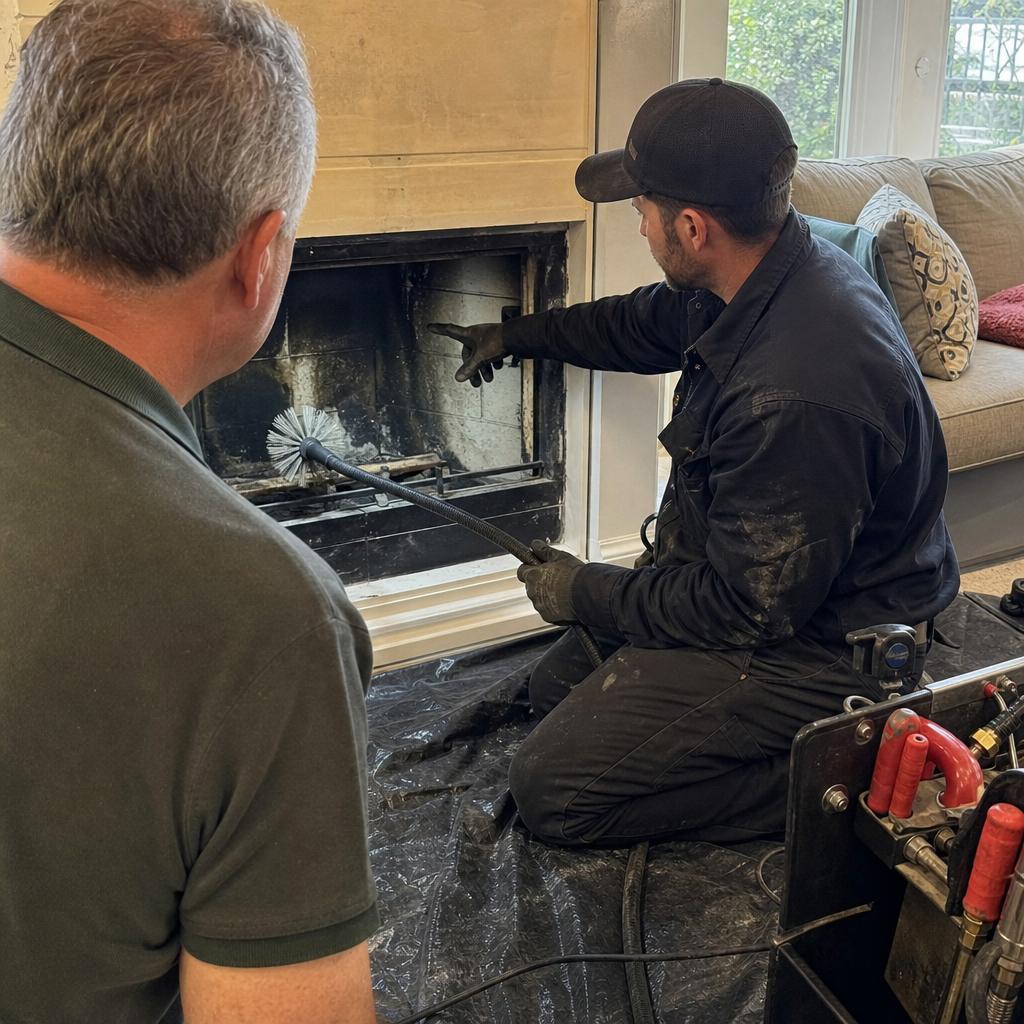
What Is Creosote Buildup? A Nashville Chimney Technician’s Guide to the Fire Risk Hiding in Your Flue
Creosote buildup is the accumulation of unburned wood tar, carbon particles, and condensed hydrocarbons that coat the inside of your chimney flue when smoke cools before it can escape. In Nashville’s older homes with original clay tile liners, this sticky, flammable residue is the leading cause of preventable chimney fires — and the small “ambiance” fires common in our city’s short-term rental properties often produce it faster than full, hot burns. If you’re noticing a tar-like odor, reduced draft, or dark flakes in your firebox, call Apex Chimney Cleaning Service Nashville at (855) 963-4743 for a camera inspection that shows exactly what stage you’re dealing with.

Why Creosote Forms: The Physics Nashville Homeowners Actually Need to Understand
Here’s the part most explainers get backwards. Creosote doesn’t form because you burned too much wood — it forms because the smoke cooled down before it left the flue.
When wood burns incompletely (low temperature, insufficient oxygen, or wet fuel), it releases volatile gases and tar droplets that would otherwise combust at higher temperatures. These unburned hydrocarbons travel up the flue as smoke. If the flue walls are cool enough — below roughly 250°F — those gases condense onto the interior surface like steam on a bathroom mirror. Layer by layer, this condensation builds into creosote.
The critical variables are temperature differential and surface texture. A hot, fast-burning fire sends gases through a warm flue quickly, leaving little time for condensation. A smoldering, low-temperature fire — the kind guests build in Nashville Airbnb fireplaces with a single split log and the damper barely open — produces cooler smoke that lingers in a cold flue. That combination is a creosote factory.
Michael Brown, Owner & Lead Technician at Apex Chimney Cleaning Service Nashville, puts it this way after eight years of flue inspections across the city: “A two-hour guest fire burning one log on a cold Nashville night cools almost immediately in an unlined clay tile flue, and deposits more creosote per BTU than a full firebox burning for eight hours.”
This matters enormously in neighborhoods like East Nashville, Sylvan Park, and Germantown, where the density of short-term rental properties is among the highest in the country. Guests burning small, low-temperature “ambiance” fires without proper fire-building knowledge create a uniquely compressed inspection and cleaning cycle that chimney professionals here encounter constantly — and that simply doesn’t exist at the same scale in comparable mid-South cities.
The Three Stages of Creosote: What Each One Actually Looks Like Inside Your Nashville Chimney
Generic articles describe creosote stages with clinical precision. Here’s what we actually find when we run our chimney camera through Nashville flues, and what each stage means for your safety and your wallet.
Stage 1: Soot and Light Dust
Stage 1 creosote is a loose, powdery layer of carbon and ash that brushes off easily with standard sweep tools. It’s normal, expected, and not immediately dangerous if addressed during routine maintenance. In owner-occupied Nashville homes where homeowners burn hot, seasoned hardwood and maintain proper draft, this is typically what we find after a season of use.
The catch: even Stage 1 creosote in an old clay tile flue with cracked, irregular interior surfaces adheres more aggressively than it would to a smooth stainless liner. Nashville’s established inner neighborhoods — East Nashville, Inglewood, Sylvan Park, 12 South, and Germantown — are dense with 1910s–1950s craftsman bungalows and brick foursquares that retain original clay-tile-lined masonry chimneys. Many have never been relined, and decades of thermal cycling and settling have left those tile interiors rough and porous. The same fire deposits more usable creosote in an old Nashville flue than in a relined one.
Stage 2: Flaky, Tar-Like Deposits
Stage 2 creosote has begun to condense into thicker, flaky, or crusty layers with a noticeable tar content. It won’t brush off with a standard brush — we need rotary cleaning tools with chains or whips to break it free. This is where the fire risk becomes real: Stage 2 creosote can ignite at temperatures as low as 451°F, and a chimney fire at this stage produces a distinctive roaring sound and can damage clay tiles through thermal shock.
In our experience, this is the stage we most commonly find in Nashville’s short-term rental properties. The pattern is consistent: guests build small fires, damp them down before leaving for Broadway, and the flue never reaches sustained operating temperature. After one busy season, a rental fireplace that would take three years to reach Stage 2 in an owner-occupied home can be there in eight months.
Stage 3: Glazed, Hardened Creosote
Stage 3 creosote is a glossy, rock-hard, tar-glazed coating that has been repeatedly heated and re-condensed until it fuses to the flue surface. Removing it requires chemical treatment — typically a powder or spray applied over multiple heating cycles to break down the glaze — followed by professional-grade rotary equipment. Most standard sweep operators don’t carry the chemicals or the specialized tools for effective Stage 3 removal.
At Apex, we use professional-grade treatment protocols and equipment from Copperfield and Olympia Chimney — the same materials specified by certified chimney specialists nationwide — to address glazed creosote without damaging underlying flue tiles. From sweep to rebuild, we handle the full scope in-house rather than referring you elsewhere.
Stage 3 creosote is genuine chimney fire fuel. It ignites at roughly 1,000°F — temperatures easily reached during normal fireplace operation — and burns with intense heat that can crack masonry, damage surrounding framing, and send flames into wall cavities. If we find Stage 3 during your inspection, we’ll show you the camera footage and explain exactly what removal involves before any work begins.
Nashville’s Creosote Accelerants: Local Conditions That Speed Buildup
Several factors specific to Nashville’s housing stock and climate make creosote formation more aggressive here than generic national advice would suggest.
- Original clay tile flues with irregular surfaces. Age and cracking create microscopic ridges and pores where creosote adheres. A relined flue with smooth stainless steel or DuraFlex liner sheds deposits far more effectively — but many Nashville homeowners don’t know whether their flue has been relined.
- The freeze-thaw transition zone. Nashville sits in a climate band where winter temperatures oscillate above and below freezing repeatedly. This subjects brick and mortar to expansion-contraction cycles more damaging than the consistently cold winters of Knoxville or the milder winters of Memphis. The resulting micro-cracks in flue tiles create additional surface area for creosote accumulation.
- The gas log conversion gap. Nashville’s intense renovation-flip market has produced a specific hazard: gas log inserts dropped into original clay tile flues without resizing or relining for the new appliance. This is a direct violation of current NFPA 211 standards, and the new owner — often an out-of-state investor — is typically unaware. An oversized flue for a gas appliance produces condensation problems with different byproducts, but the underlying issue (improper venting, moisture damage, and hidden deterioration) remains. Homeowners who converted to gas logs sometimes think creosote is no longer their concern, yet the unaddressed liner problem creates its own set of risks.
- Nearly 47 inches of annual rainfall combined with high humidity. Moisture intrusion through cracked crowns and spalling mortar joints — common in pre-1950s Nashville chimneys — accelerates interior deterioration and creates damper conditions that promote creosote adhesion.
Creosote Buildup vs. Normal Soot: How to Tell What You’re Looking At
Not every dark deposit in your firebox or flue is dangerous creosote. Here’s how to distinguish what you’re seeing before you call for service.
| What You See | What It Likely Is | Action Needed |
|---|---|---|
| Loose black powder that wipes off with a finger | Normal soot/ash | Routine sweep during next scheduled maintenance |
| Flaky, brownish-black material with tar smell | Stage 2 creosote | Schedule professional cleaning soon — fire risk developing |
| Shiny, glassy black coating that won’t scratch | Stage 3 glazed creosote | Immediate professional treatment — significant fire hazard |
| White or gray powdery residue | Efflorescence or flue gas residue (often from gas) | Inspection to identify source; may indicate liner sizing issue |
| Moisture stains with musty odor | Water intrusion, not creosote | Crown/cap inspection for leaks; separate from creosote concern |
Our honest advice: if you’re not certain what you’re seeing, don’t guess. A chimney camera inspection takes fifteen minutes and removes the uncertainty entirely. We’ve had Nashville homeowners panic over harmless soot and ignore genuine Stage 3 glaze because they looked similar from the firebox opening.
What Professional Creosote Removal Costs in Nashville
Pricing varies with accessibility, flue condition, and creosote stage. Here’s what Nashville homeowners typically invest:
| Service | Typical Range | What’s Included |
|---|---|---|
| Standard chimney sweep (Stage 1) | $175 – $250 | Brush and vacuum cleaning of flue, smoke chamber, and firebox; basic inspection |
| Rotary creosote removal (Stage 2) | $275 – $425 | Powered rotary cleaning with chain/whip tools; camera inspection; debris removal |
| Glazed creosote treatment (Stage 3) | $450 – $750 | Chemical application cycle(s), professional-grade rotary removal, full camera documentation |
| Camera inspection only | $125 – $195 | Video documentation of flue condition; written assessment with no pressure to book service |
These ranges reflect Nashville’s market specifically. Factors that push toward the higher end include steep roof pitch (common in craftsman bungalows), multiple flues, and fireplaces that haven’t been serviced in several years. We provide upfront pricing before any work begins — no surprises when we’re on your roof.
Call (855) 963-4743 for an exact quote on your specific situation. Estimates are free, and we’ll tell you honestly if your creosote level doesn’t yet warrant professional intervention.
How to Minimize Creosote Buildup: Practical Steps for Nashville Fireplaces
We’re not going to hand you a DIY guide for flue work — that’s genuinely dangerous, and the Chimney Cleaning & Sweep we provide exists for good reason. But we will tell you the operational habits that reduce creosote formation between professional visits.
Burn hot, not long and low. A smaller, intensely hot fire produces less creosote than a large, smoldering one. Use seasoned hardwood (moisture content below 20%), build the fire with adequate air supply, and avoid closing the damper to “stretch” the burn.
Don’t burn “ambiance” fires. The single log, low-flame aesthetic fire is the worst possible pattern for creosote. If you’re not going to maintain a hot, active burn, don’t light it.
Warm the flue before the main fire. In cold weather — common in Nashville’s winter snaps — a cold flue will condense smoke immediately. Roll a newspaper into a torch, light it, and hold it up the damper for 30-60 seconds to preheat the flue before building your main fire.
Know your liner status. If you don’t know whether your flue has been relined, find out. A smooth stainless liner from Gelco or Famco dramatically reduces creosote adhesion compared to original clay tile. We document liner condition during every inspection and can show you exactly what you have.
Schedule based on use pattern, not calendar. The NFPA 211 standard recommends annual inspection for all chimneys, but cleaning frequency depends on use. A Nashville Airbnb fireplace with weekly guest fires needs more frequent attention than an owner-occupied home with occasional weekend use. We’ve built relationships with property managers across the city who schedule us between guest turnovers during peak season.
FAQs
Standard creosote removal in Nashville typically runs $175–$250 for Stage 1 buildup, $275–$425 for Stage 2 requiring rotary tools, and $450–$750 for glazed Stage 3 creosote needing chemical treatment. The exact price depends on your flue’s accessibility, the severity of buildup our camera inspection reveals, and whether your chimney has been maintained on schedule or neglected for several seasons. Call (855) 963-4743 for a free estimate — we’ll assess your specific situation and provide upfront pricing before any work begins.
Yes — creosote buildup is the leading cause of preventable chimney fires in Nashville and nationwide. Stage 2 creosote ignites at temperatures as low as 451°F, and Stage 3 glazed creosote at roughly 1,000°F, both easily reached during normal fireplace operation. A chimney fire produces a distinctive roaring sound, can crack clay flue tiles through thermal shock, and may allow flames to reach surrounding structural materials. The risk is especially elevated in Nashville’s older homes with original clay tile liners that have developed cracks from decades of thermal cycling. If you suspect significant buildup, schedule a camera inspection rather than continuing to use the fireplace.
Gas fireplaces do not produce creosote — that’s a wood combustion byproduct — but they can develop their own venting problems that create similar risks. In Nashville, we frequently find gas log inserts installed in original clay tile flues that were never resized or relined for the new appliance, a direct NFPA 211 violation common in renovation flips. An oversized flue for a gas unit produces excessive condensation of water vapor and combustion byproducts, leading to moisture damage, liner deterioration, and potential carbon monoxide venting issues. If you converted from wood to gas and never had the liner professionally assessed, the creosote concern may be gone but a different safety gap likely remains.
The NFPA 211 standard recommends annual inspection for all chimneys regardless of use, but Nashville’s specific conditions — high short-term rental density, original clay tile flues in pre-1950s housing stock, and a climate with repeated freeze-thaw cycles — mean many local fireplaces benefit from more frequent attention. For owner-occupied homes with moderate wood burning, annual inspection with cleaning as needed is typically sufficient. For short-term rental properties with frequent guest fires, we often recommend inspection every six months or between peak seasons. After eight years inspecting Nashville flues, we’ve found that rental fireplaces can reach Stage 2 creosote in a single busy season — a timeline that surprises many property owners who assumed annual service was adequate.
When to Call Apex Chimney Cleaning Service Nashville
If you’re unsure what stage of creosote is in your flue, if you’ve noticed a tar-like odor, reduced draft, or any of the visual signs we’ve described, or if you simply don’t know when your chimney was last professionally inspected, we’re straightforward to reach. Michael leads every job personally — you’ll get the decision-maker on your roof, not a rotating crew of subcontractors — and our camera inspection shows you exactly what we’re seeing, with no pressure to book services you don’t need.
Nearly 800 homeowners across Nashville have trusted us with their chimney systems, and we’ve built that 4.9-star reputation by being honest about what needs doing now versus what can wait. A clean chimney isn’t a luxury — it’s just maintenance you can see the point of when something goes wrong.
If you’d rather have it looked at, Apex Chimney Cleaning Service Nashville offers a no-pressure assessment in Nashville — call (855) 963-4743.
Written by Michael Brown, Owner & Lead Technician at Apex Chimney Cleaning Service Nashville, serving Nashville, TN.